
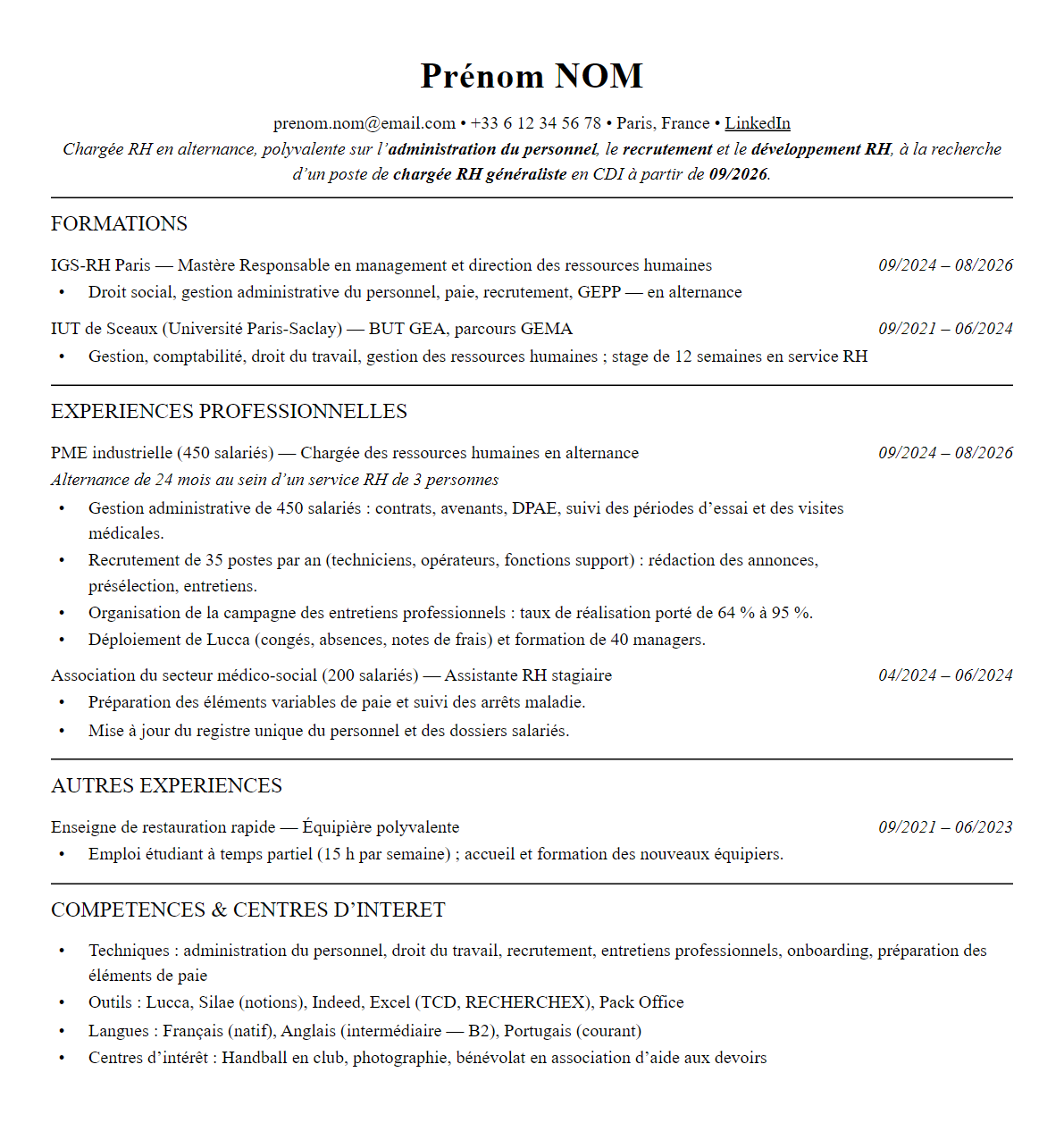
HR generalist or HR specialist: which path to choose and how to write your CV
Sooner or later, every HR professional faces the question: should you stay a generalist, able to run the whole HR function for a site or a small company, or specialise in one area such as payroll, recruitment, learning, compensation or HRIS? The answer is not just a matter of taste. It shapes the roles you can apply for, the recruiters who will read your CV and, above all, how that CV should be built.
This guide helps you think it through: what each path really involves in the French market, the bridges between them, and how to write a CV that owns your positioning instead of blurring it.
What "generalist" means in HR
An HR generalist manages the entire employee lifecycle within a given scope. Job titles vary with company size: chargé·e RH (HR officer), site HR manager (RRH de site), HR manager in an SME, HR generalist in an international group, sometimes HRBP when the role leans towards advising managers.
Day-to-day work typically covers:
- personnel administration (contracts, amendments, the mandatory staff register, occupational health appointments, absences);
- payroll review or control, even when payroll is outsourced;
- first-level recruitment and onboarding;
- the skills development plan and the mandatory professional reviews (entretiens professionnels);
- relations with the CSE (the French works council) and meeting preparation;
- sensitive individual cases: disciplinary procedures, unfitness for work, mutually agreed terminations (ruptures conventionnelles).
A generalist's value lies in versatility and close knowledge of the field. Employees usually come to them first, and they are often the ones who see problems coming before they turn into litigation.
What "specialist" means
A specialist goes deep into one area and becomes the internal or external reference for it. The main specialisms in France:
| Specialism | Common titles | Top priorities | |---|---|---| | Recruitment | Recruiter, talent acquisition, sourcer | Sourcing, process management, hiring manager relations | | Payroll and administration | Payroll officer, payroll manager | Accuracy, collective agreement monitoring, DSN filings | | Learning / L&D | Training officer, L&D manager | Instructional design, funding, plan management | | Compensation | Comp & Ben, reward manager | Salary surveys, pay policy, annual negotiations | | HRIS / data | HRIS project manager, people analyst | Configuration, data quality, reporting | | Industrial relations | Employee relations manager | Collective bargaining, labour law |
Specialists are judged on depth: command of a tool, a regulation or a method. They usually work in organisations large enough to justify a dedicated role, or in consultancies and software vendors.
The two paths: benefits and limits
Staying a generalist
What you gain:
- a complete view of the function, essential if you are aiming for HR manager and then HR director roles;
- strong employability in SMEs and mid-sized companies, where one person often covers the whole spectrum;
- close ties with managers and the business, good preparation for HRBP roles.
Where it can hurt:
- the risk of being seen as a jack of all trades with no proven expertise;
- difficulty entering a large group in an expert role;
- a CV that reads like a job description unless you highlight specific achievements.
Specialising
What you gain:
- identifiable expertise, easy to find through keyword searches in an ATS;
- access to environments that value technical depth: shared service centres, consultancies, HRIS vendors, large groups;
- a clear path to head-of-domain roles.
Where it can hurt:
- a scope that can shrink if the specialism gets automated or outsourced;
- moving back into a generalist role can be harder to justify;
- the risk of losing touch with operations and managers.
How to choose: four questions
1. What energises you day to day? If you enjoy moving from a disciplinary meeting to a CSE session and then a recruitment update, you are probably a natural generalist. If you prefer digging into one topic, fixing a payroll anomaly or modelling a salary grid, specialisation will suit you better.
2. Which role are you aiming for in five to ten years? HR director roles require a cross-functional view: many HR directors come from generalist backgrounds, or broadened their scope after a specialism. Head of payroll, reward director or head of talent acquisition roles require deep expertise instead.
3. What kind of company do you want to work for? SMEs hire few specialists. Large groups have structured expert tracks.
4. Does your specialism have regulatory or technical depth? Payroll, compensation and industrial relations rest on a legal foundation that keeps changing, which makes the expertise durable. Other specialisms depend more on the tools of the moment.
Bridges between the two
HR careers are rarely linear, and that is good news. A few classic moves:
- Generalist to specialist: an HR officer in an SME who ran payroll in-house can move into a payroll role in a group; a site HR manager who led several high-volume hiring campaigns can position themselves in talent acquisition.
- Specialist to generalist: a recruiter who supported managers through onboarding and probation periods can target HR manager or HRBP roles. To understand how those two roles differ, read our article on HRBP vs HR manager CVs.
- The T-shaped profile: a solid generalist base plus a clear specialism. It is often the most readable positioning for a recruiter, provided the CV shows it clearly.
The generalist CV: proving versatility without scattering
The generalist's main challenge is avoiding the catalogue CV. Listing every HR task in existence says nothing about your level; everyone has "managed personnel administration".
The summary
State your scope (headcount, number of sites, sector, whether there is a CSE) and two or three areas where you truly made a difference.
HR generalist, 5 years in an industrial SME (220 employees, 2 sites). Autonomous on personnel administration, review of outsourced payroll and CSE relations. Structured the onboarding process and the tracking of mandatory professional reviews.
Experience: group by domain
Instead of a list of ten tasks, group your achievements by domain within each role:
Before:
Personnel administration, payroll follow-up, recruitment, training, employee relations.
After:
Administration and payroll — monthly payroll review for 220 employees with the external provider; introduced a variables checklist that ended recurring corrections. Employee relations — prepared and minuted 11 CSE meetings a year; organised works council elections. Development — led the professional review campaign: 100% of six-year reviews completed on time.
Skills
Separate the legal foundation (labour law, collective agreements, DSN) from tools (Lucca, Silae, Excel, your payroll suite) and from interpersonal skills demonstrated in your experience.
If you would rather start from a ready-made base, open the pre-filled HR generalist CV and replace the examples with your own achievements.
The specialist CV: proving depth
For a specialist, the reader is often an expert in the same field. They spot vague vocabulary immediately.
The summary
Name your specialism in the first words, then the technical elements that set you apart.
Payroll specialist, 6 years in an accounting firm then in-house. Multiple collective agreements (Syntec, metalworking), 400 payslips a month, proficient in Silae and DSN. Go-to person for corrections and URSSAF audits.
Experience: volume, complexity, reliability
A specialist should give concrete benchmarks: volumes handled, collective agreements, tools configured, projects delivered.
Before:
Recruitment of various profiles for different departments.
After:
Hired 45 technical profiles a year (maintenance, quality, methods); introduced direct sourcing on LinkedIn Recruiter, reducing reliance on agencies.
For a detailed example of what a specialism requires, see our guide to the payroll specialist CV, with the tools and references to mention.
Skills
For specialists, the skills section is read closely because it also feeds keyword searches. Be precise: "Silae (pay item configuration)" rather than "payroll software".
The T-shaped profile: writing it without contradiction
Many HR professionals have a generalist base and a strong specialism. The trap is a hesitant CV that never chooses. The method:
- Pick the target role and adapt the summary accordingly. The same experience can be told differently depending on whether you apply as HR manager or in C&B.
- Lead with the specialism in your achievements if you target an expert role, and with the overall scope if you target a generalist role.
- Keep one summary line that owns both: "HR generalist with a recruitment focus", "HR manager with payroll expertise".
Site HR manager (300 employees, logistics), payroll and working-time expertise: led the switch to new time-management software and the annualised working-time agreement.
Common mistakes
- A vague title: "Versatile HR assistant" when you actually ran the HR function of an SME alone. Use the title that reflects your real role, while staying honest.
- Too many tools without context: a list of ten software packages does not show which ones you truly master.
- No volumes: headcount covered, number of hires, payslips, CSE meetings. Without these, the recruiter cannot gauge your level.
- The same CV for every role: a generalist applying for a specialist role needs to reorder their achievements.
Conclusion
There is no right or wrong choice between HR generalist and specialist: there is clear positioning, or blurred positioning. Your CV should show within seconds where you stand, with concrete achievements to back it up. You can build or adapt your CV directly in the RH-CV editor, or start from the pre-filled HR generalist CV.
Frequently asked questions
Can an HR generalist become an HR director?
Yes, it is a common path: versatility and field knowledge are assets for a leadership role. You will need to show you can drive strategic topics, such as an organisational transformation or collective bargaining. Our article on the HR director CV details those expectations.
Do I need a specific degree to specialise?
Not necessarily. In many specialisms, experience and tool proficiency matter more. A certified training course can, however, speed up an internal move into payroll or HRIS, for example.
How should I present a generalist role when applying for a specialist one?
Keep the real job title but reorder your achievements: start with those related to the target specialism and summarise the rest in one line. The summary should announce the specialism.
Is the T-shaped profile really in demand?
It is readable and reassuring for many recruiters because it combines a global understanding with expertise. It works as long as the CV clearly ranks the two dimensions for the role in question.