
Payroll Specialist Resume: Examples, Software Skills, and Certifications
Payroll is one of the most technically demanding functions in HR: zero tolerance for inaccuracy, constantly evolving regulations, and software tools that vary significantly from one organization to the next. Your payroll specialist or payroll manager resume must reflect this rigor — every line should prove that you understand employment law, master the tools, and can operate without error in complex payroll environments.
This guide walks you through the optimal structure for a payroll CV, the software skills you must highlight, certifications that give you an edge, and the common mistakes that get candidacies dismissed on first read.
Resume Structure for a Payroll Professional
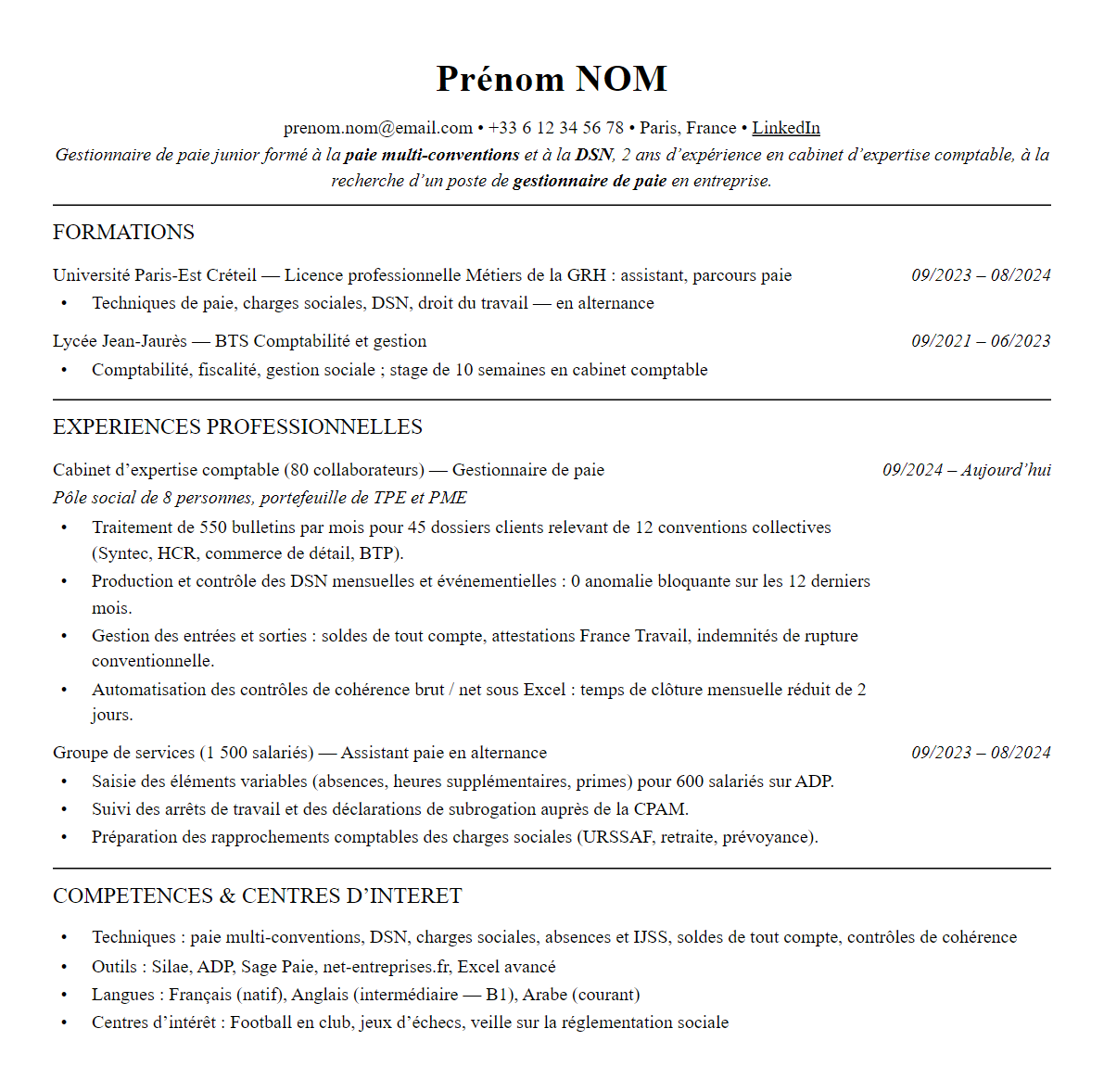
A payroll specialist resume is not a generic HR resume. The people reviewing it — often a Payroll Manager, an HR Director, or a specialized recruitment firm — are looking for specific signals: which software, how many payslips processed, which collective agreements, how much regulatory complexity.
Recommended structure:
- Clear job title: "Senior Payroll Specialist" or "Payroll & HR Administration Manager" — not "versatile HR profile"
- Profile summary (4-5 lines): volume of payslips processed, industry sectors covered, organization types, specializations (multi-site payroll, international payroll, expatriate management)
- Technical skills: software tools, regulatory areas mastered, reporting capabilities
- Professional experience: reverse chronological, quantified bullet points
- Education and certifications: degrees, professional qualifications, continuing education
- Languages: relevant if international payroll or multinational group context applies
Payroll Software to Include on Your Resume
Proficiency in one or more payroll software systems is non-negotiable. A recruiter who sees no software listed will remove the resume immediately. Here are the main tools in the French market and their typical deployment contexts:
Generalist software (SME/mid-market):
- Sage Paie & RH (Sage 100, Sage Business Cloud): most widely used in French SMEs
- Cegid HR (formerly Cegid Pégase): widely deployed in retail and hospitality
- Silae: fast-growing SaaS platform, heavily used in accounting firms and growing mid-size companies
- Quadra Paie (ACD Group): common in accounting firms and small businesses
Enterprise-grade software:
- ADP GlobalView / ADP Decidium: the reference for large groups and multi-country payroll
- SAP HCM / SAP SuccessFactors Employee Central Payroll: essential in large industrial and service groups (Carrefour, ENGIE, Sodexo, LVMH)
- Workday Payroll: increasingly deployed in tech companies and international scale-ups
- Oracle HCM Cloud: present in major listed companies
Complementary tools worth mentioning:
- Advanced Excel (pivot tables, complex formulas, VBA macros for payroll reconciliations)
- HR reporting tools: Power BI, Tableau, BusinessObjects
- Time and attendance management: Chronotime, Kelio, TimeMoto, Horoquartz
Always indicate your proficiency level honestly: "Sage Paie (expert, 6 years)", "SAP HCM (advanced user, 2 years)", "Silae (currently training)".
Regulatory Mastery: What to Write (and Not Forget)
French payroll regulation is among the most complex in the world. Your resume must signal that you can navigate this environment. Here are the regulatory elements to include, matched to your experience level:
Non-negotiable for every payroll professional:
- DSN (Déclaration Sociale Nominative): must be mentioned — specify the volume and frequency (monthly, event-triggered)
- Withholding tax (Prélèvement à la source — PAS): collection, regularization, handling edge cases (multiple employers, personalized rates)
- Collective bargaining agreements (Conventions collectives): list the CCAs you truly master, with their IDCC code where possible. Example: Metallurgy CCA (IDCC 1939), Retail Trade CCA (IDCC 1880), Fast Food CCA (IDCC 1501)
For experienced payroll professionals:
- Profit-sharing and employee savings plans (intéressement, participation, PEE/PERCO/PER): formula calculation, employee communications, disbursement management
- Expatriate and impatriate payroll: social security contribution bases, bilateral social security conventions, reference salary calculation
- Sick leave and provident insurance (prévoyance): salary subrogation, contractual salary maintenance, waiting period management by collective agreement
- Meal vouchers, professional expenses, fringe benefits: exemptions, contribution bases
For payroll managers:
- URSSAF audits: preparation, handling assessments, liaising with inspectors
- Social report and payroll KPIs: average labor cost, analytical payroll mass, group reporting
Certifications That Add Value to Your Payroll Profile
Titre Professionnel Gestionnaire de Paie (TPGP) — issued by the French Ministry of Labor, equivalent to a two-year post-secondary qualification (RNCP Level 5). This is the reference certification for entry-level and career-change payroll candidates. It covers payslip calculation, DSN declarations, social security contributions, and HR administration.
BTS Comptabilité et Gestion (HR option) — a classic route providing solid foundations in employment law and payroll accounting.
Licence Pro Gestion des Ressources Humaines (payroll/administration specialization) — for candidates looking to build on a BTS qualification.
DSCG (Diplôme Supérieur de Comptabilité et de Gestion) — Units 1 (legal, tax and social management) and 3 (management control) are directly relevant for payroll managers who engage on social taxation topics.
Software vendor certifications:
- Sage Paie certification (offered by Sage and its partner network)
- Silae Academy certification program
- SAP HCM certification (modules HR050, HR305, HR400)
Recommended continuing education:
- Lefebvre Dalloz (formerly Francis Lefebvre) payroll regulatory updates
- ADP and Cegid webinars on legislative changes
- ANDRH working groups on current topics (pension reform, profit-sharing, pay equity index)
Writing Bullet Points That Work
A payroll resume without numbers lacks credibility. Use this structure for every bullet point:
Action + Context + Volume/Complexity + Result
Real-world examples:
- "Independently managed a portfolio of 320 monthly payslips across 4 establishments under the Hospitality CCA (IDCC 1979), with zero payroll errors over 24 consecutive months."
- "Led migration from Sage Paie to SAP HCM for 1,800 employees over 6 months, coordinating with the software vendor and IT teams, with no disruption to the payroll cycle."
- "Automated social charges reconciliation in Excel VBA, reducing the monthly payroll close from 3 days to 1.5 days."
- "Prepared and managed a 3-year URSSAF audit at a 2,200-employee distribution group, resulting in a final assessment 85% lower than the initial inspector's proposal."
- "Trained and supervised a team of 4 payroll specialists during the launch of a shared services center (SSC) handling payroll for 7 subsidiaries."
"Isabelle, payroll manager at a 3,500-employee hospitality group, shared: 'I had listed my software tools but without specifying the volumes or the collective agreements I worked with. A recruiter told me directly that this was what was missing to assess my level. Since adding volumes and IDCC codes, my response rate on applications has doubled.' (Illustrative profile)"
Common Mistakes on Payroll Resumes
1. Vague software mentions Writing "proficiency in payroll software" without naming any tool is fatal. The recruiter needs to know whether you can be operational from day one or whether a lengthy training period will be required.
2. No data on volumes "Payroll management" without specifying how many payslips, how many sites, what contractual complexity, provides no basis for evaluating your capacity to handle the role.
3. No mention of collective agreements mastered Every CCA has its own specifics (bonuses, allowances, classification scales). A recruiter in hospitality wants to know if you've already applied IDCC 1979 — not just "the relevant CCA."
4. No evidence of regulatory rigor Payroll is compliance. If your resume doesn't mention DSN, URSSAF controls, withholding tax, or profit-sharing (at the appropriate level), the recruiter will question whether you follow the social legislation calendar.
5. Confusing HR administration with payroll HR administration (contracts, DPAE notifications, health insurance enrollment, occupational medicine) is often handled by the same person as payroll, but they are distinct skill sets. If you do both, say so clearly and separate the competency blocks.
6. Poor formatting A payroll resume with misaligned columns or an illegible font sends the wrong signal for a role where precision is everything. Use a structured tool like RH-CV to ensure a flawless presentation.
Sample Payroll Profile Summary
Senior Payroll Specialist — 7 Years of Experience
Versatile payroll specialist with 7 years of experience in SMEs and mid-market companies (80 to 850 employees). Full payroll cycle ownership on Sage 100 Paie and Silae, autonomous management of monthly and event-triggered DSN declarations, strong working knowledge of the metallurgy (IDCC 1939), road transport (IDCC 16), and wholesale trade (IDCC 573) collective agreements. Certified Gestionnaire de Paie (TPGP). Comfortable with profit-sharing calculations, employee savings plan management, and sick-leave salary subrogation.
This profile is short, dense, and immediately answers the questions any recruiter will have.
Want a head start? Open the pre-filled payroll resume in the editor and replace each line with your own experience.
FAQ
Which payroll software is most in demand in France in 2025?
Sage Paie remains dominant in SMEs, but Silae is growing fast in accounting firms and mid-market companies. ADP Decidium is essential in large industrial and services groups, and SAP HCM/SuccessFactors is required in multinationals. Knowing at least two of these tools is a significant advantage.
Is the Titre Professionnel Gestionnaire de Paie certification essential?
It is highly valued for candidates without an initial HR or accounting qualification. For candidates from a BTS CGO or a professional bachelor's in HR, it's less critical but always a plus. For a Payroll Manager role with team management responsibilities, supplementary training in management and advanced employment law carries more weight.
How do I transition into payroll from another HR or accounting role?
The most common route is the Titre Professionnel Gestionnaire de Paie through continuing education (available in-person, online, and through work-study programs). Pair it with hands-on practice on a software platform (Silae and Sage both offer training environments), and target a first payroll role at an accounting firm or through a specialized HR staffing agency (Kelly Services, Expectra, Adecco PME).
Should I list collective bargaining agreements on my resume?
Absolutely — and with precision. Not listing CCAs forces the recruiter to ask the question in the interview. Include the full name and/or IDCC code of the agreements you genuinely master. Avoid listing 15 CCAs you've only briefly encountered: three or four thoroughly mastered agreements are far more credible than a long, unconvincing list.
What is the difference between a payroll specialist and a payroll manager on a resume?
A payroll specialist produces payslips, manages DSN declarations, and handles anomalies. A payroll manager supervises a team, drives HRIS projects related to payroll, manages URSSAF relations, and produces payroll mass reporting for senior management. If you do both, clarify in your title: "Payroll & HR Administration Manager" and detail both dimensions in your profile summary.
How should I present contract or short-term assignments on a payroll resume?
Group assignments from the same staffing agency or firm under a single block labeled "Contract assignments via [Agency]." Then detail the two or three most significant client assignments with company name, sector, payslip volume, and software used. Contract experience in payroll is highly valued because it signals strong adaptability and rapid skill acquisition across diverse payroll environments.
Further Reading
Read our article on the HRIS resume and the tools to mention to understand how payroll expertise connects to broader HRIS project work.
Build your payroll resume with RH-CV — structure your competencies, software skills, and certifications in a clear, professional format.